Skip to content
Menu

Practice 05 of 06

Public rails built without
ceding control.

We advise central banks, ministries of finance and sovereign funds on payment switches, foundational identity, customs single windows and disciplined reserve governance.

ContinuePayment switch diagram: 16 live country nodes expanding toward 19+ central banks on local-currency net settlement (PAPSS 2025 to 2026). Schematic.

What the line does

States build programmable money with thin independent counsel.

Our mandate sits where a central bank, treasury or regulator requires vendor-neutral design across clearing rails, foundational ID, single-window customs, tokenisation governance and reserve strategy.

Across monetary authorities, enquiry into public digital money is near universal: 91% of 93 surveyed central banks were exploring a retail or wholesale CBDC in 2024, covering roughly 94 per cent of global GDP. In that same survey, >1 in 3 central banks accelerated their work in response to private stablecoins. 91%of 93 surveyed central banks (85 institutions) were exploring a retail or wholesale CBDC in 2024, covering about 94% of global GDP.Source: BIS, 2024 CBDC survey (BIS Papers No. 159), 2025. Open the publication ↗>1 in 3 central banksShare of surveyed central banks that accelerated CBDC work in response to stablecoins and other cryptoassets.Source: Bank for International Settlements, 2024 CBDC survey (BIS Papers No. 159). Open the publication ↗
Yet only 3 jurisdictions had launched live retail CBDCs by that survey: the Bahamas, Jamaica and Nigeria. The distance between study and operation is where vendor pitches proliferate and where independent sovereign architecture matters most. 3jurisdictions with live retail CBDCs: the Bahamas, Jamaica and Nigeria.Source: BIS, 2024 CBDC survey (BIS Papers No. 159). Open the publication ↗
  • Who retains this practiceCentral banks, ministries of finance, sovereign wealth funds, civil-registration agencies and national customs authorities.
  • Decisions we supportHow to join PAPSS or BIS Project Nexus, how to procure foundational ID without vendor lock-in, how to govern tokenised public assets, and how to benchmark FX reserve diversification against IMF COFER.

Central-bank CBDC engagement, 2018 to 2024

Share of surveyed central banks conducting CBDC work (%). High plateau against 3 live launches.

70% to 91%Share of surveyed central banks conducting CBDC work across BIS surveys: 70% (2018), 80% (2019), 86% (2020), 90% (2021), 93% (2022), 94% (2023) and 91% (2024).Source: Bank for International Settlements, Annual CBDC surveys (BIS Papers No. 107 to 159, 2018 to 2024). Open the publication ↗91%of 93 surveyed central banks (85 institutions) were exploring a retail or wholesale CBDC in 2024, covering about 94% of global GDP.Source: BIS, 2024 CBDC survey (BIS Papers No. 159), 2025. Open the publication ↗3jurisdictions with live retail CBDCs: the Bahamas, Jamaica and Nigeria.Source: BIS, 2024 CBDC survey (BIS Papers No. 159). Open the publication ↗
50%60%70%80%90%100%70%201886%2020202294%91%2024
Source: BIS Annual CBDC Surveys (BIS Papers No. 107 to 159, 2018 to 2024).Live retail CBDCs: 3

Scale of the sovereign shift

Continental rails clear trillions while FX friction drains budgets.

The practical return sits in clearing local-currency trade, verifying residents and cutting manual customs delays.

$1.98 trillion

processed by Africa's instant-payment systems across 64 billion transactions in 2024

Ecofin Agency, 2025, citing AfricaNenda

$1.98 trillionprocessed by Africa's instant-payment systems across 64 billion transactions in 2024.Source: Ecofin Agency, 2025, citing AfricaNenda. Open the publication ↗
~$5bn/yr

Cost of settling intra-African trade in USD

Afreximbank / PAPSS, 2023-2025

~$5bn/yrCost of settling intra-African trade in USD.Source: Afreximbank / PAPSS, 2023-2025. Open the publication ↗
~500 million

people without legal identity live in sub-Saharan Africa, about 56% of the global total

World Bank ID4D, 2021; Biometric Update, 2023

~500 millionpeople without legal identity live in sub-Saharan Africa, about 56% of the global total.Source: World Bank ID4D, 2021; Biometric Update, 2023. Open the publication ↗

How an engagement runs

One integrated national stack replaces fragmented vendor bids.

Identity authenticates the payer, the payment rail moves value, the single window logs trade obligations and reserve rules safeguard external liquidity.

Sovereign platform stack · schematicID4D · ISO 20022 · PAPSS · COFER
LAYER 01 · DIAGNOSTICS & ID4DLeakage audit · credential rulesLAYER 02 · ISO 20022 PAYMENT RAILInstant switch · BIS Nexus 60sLAYER 03 · PAPSS & SINGLE WINDOWLocal clearing · customs ledgerLAYER 04 · COFER & ASSET RULESReserve board · custody charter

Schematic architecture. Each public-infrastructure layer activates as you move through the four phases.

Step 01 · Sovereign mandate and baseline

Quantify exclusion, offshore leakage and customs delay

We measure the state's recurring losses before choosing technology: unverified resident populations, offshore dollar-correspondent fees and days lost to manual permit approval.

Standards: World Bank ID4D · Global Findex · Remittance benchmarks
Step 02 · Interoperability and legal design

Design open protocols before issuing tenders

We architect a shared identity-to-payments interface built on ISO 20022 and BIS Project Nexus principles (targeting 60 seconds settlement across interlinked switches) so the state owns its data and rules. 60 secondstarget settlement time under BIS Project Nexus, interlinking domestic instant-payment systems for a first-wave market of ~1.7 billion people.Source: Bank for International Settlements, Project Nexus blueprint (2024). Open the publication ↗
Standards: ISO 20022 · BIS Project Nexus blueprint (2024)
Step 03 · Procurement and PAPSS integration

Onboard banks, switches and customs without lock-in

We manage vendor-neutral procurement, set intra-day liquidity and net-settlement limits for PAPSS participation, and connect the national electronic single window for timestamped duty collection.

Standards: PAPSS rulebook · UNCTAD Electronic Single Window
Step 04 · Reserve and tokenisation oversight

Institutionalise COFER reserve discipline and governance

We establish board reserve-risk committees, benchmark multi-currency and gold diversification to IMF COFER, and frame sovereign asset-tokenisation rules with strict separation from commercial mandates.

Standards: IMF COFER reporting · No-overlap governance charter

Inclusion, settlement and reserves

Dollar settlement drag bites harder than gradual reserve drift.

Account ownership in Sub-Saharan Africa more than doubled between 2011 and 2021, yet nearly half of African trade payments still route in US dollars.

Adult account ownership, 2011 to 2021

Share of adults age 15+ holding an account (%). Mobile money lifted SSA to 33% of adults.

55%of adults in Sub-Saharan Africa held an account in 2021 (33% via mobile money), up from 23% in 2011.Source: World Bank Global Findex Database 2021 (2022). Open the publication ↗23% to 55%Rise in Sub-Saharan African adult account ownership from 2011 (23%) through 2014 (34%) and 2017 (43%) to 2021 (55%), against 42% to 71% across developing economies.Source: World Bank, Global Findex Database 2021 (2022). Open the publication ↗
Developing economiesSub-Saharan Africa0%20%40%60%80%42%23%201154%34%201463%43%201771%55%2021
Full digital-ID coverage potential: 3% to 13% of GDP by 2030 (MGI 2019).Source: Global Findex 2021

US dollar share of allocated global FX reserves

Year-end % of allocated reserves (2015 to 2025). Gradual drift, not sudden abandonment.

56.77%USD share of allocated global FX reserves, 2025 Q4.Source: IMF COFER data brief, 2026. Open the publication ↗65.7% to 56.77%Decade-long drift in US dollar share of allocated global FX reserves from 2015 year-end (65.7%) to 2025 Q4 (56.77%), with the euro near 20.25% and renminbi near 1.95%.Source: IMF COFER data brief (2015 to 2026). Open the publication ↗
50%55%60%65%70%65.7%2015201958.9%2021202356.77%2025
2025 Q4: USD 56.77%, EUR ~20.25%, RMB ~1.95%.Source: IMF COFER
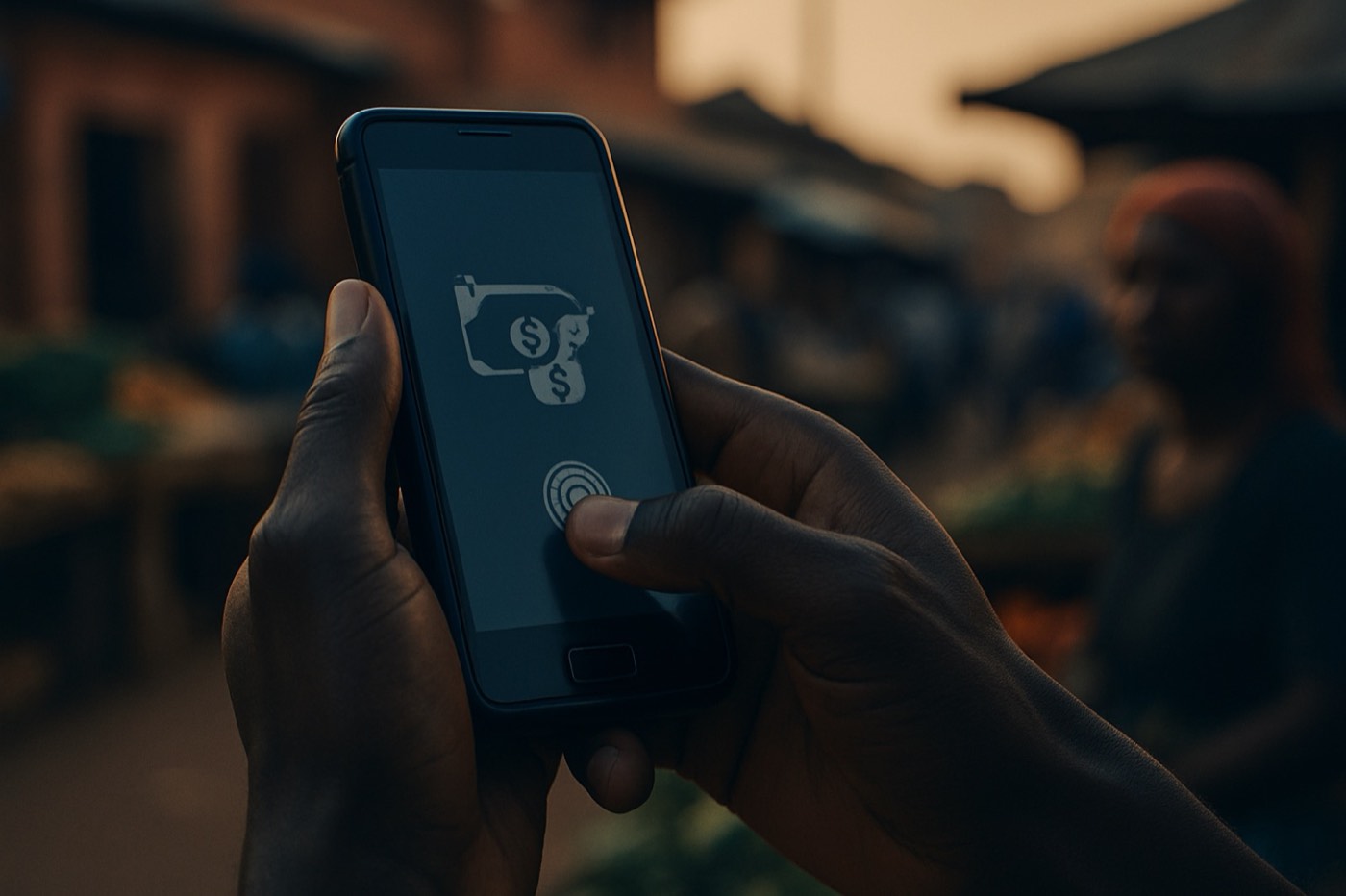
Close view of two hands operating a mobile phone displaying a digital payment transfer interface in an outdoor market
Illustration generated for Magna.
The reserve picture argues for discipline rather than slogans. Sub-Saharan African sovereign wealth funds hold roughly ~$160bn in assets under management, while about ~49% of African trade payments settle in US dollars. ~$160bnAUM of Sub-Saharan African sovereign funds.Source: Cleary Gottlieb / Global SWF, 2024. Open the publication ↗~49%African trade payments settled in US dollars.Source: Afreximbank / SWIFT, 2023-2025. Open the publication ↗
Remittances to Sub-Saharan Africa averaged 7.9% in 2023 against the sub-3 per cent SDG goal, and roughly ~850 million people worldwide still lacked official identity in 2021. Every unit of intra-African trade cleared locally relieves scarce hard-currency reserves directly. 7.9%average cost of sending remittances to Sub-Saharan Africa in 2023, the most expensive region, against the sub-3% SDG target.Source: World Bank Remittance Prices Worldwide (2023-2024). Open the publication ↗~850 millionpeople lacked official proof of identity in 2021, down from about 1 billion in 2018.Source: World Bank ID4D Global Dataset, 2021. Open the publication ↗

Practice workbench

Inspect four sovereign workstreams and model local clearing savings.

Compare workstream controls without JavaScript, then adjust the illustrative bilateral trade and PAPSS routing parameters below.

Select a sovereign workstream to review benchmarks and safeguards

Local-currency clearing and instant-payment switches

Connects national switches to PAPSS and interlinking rails modelled on BIS Project Nexus (60 seconds target), capturing up to 27% per-transaction savings against the ~US$5 billion / year continental offshore cost pool. 60 secondstarget settlement time under BIS Project Nexus, interlinking domestic instant-payment systems for a first-wave market of ~1.7 billion people.Source: Bank for International Settlements, Project Nexus blueprint (2024). Open the publication ↗up to 27%Per-transaction cost saving via PAPSS.Source: Afreximbank / PAPSS, 2025. Open the publication ↗~US$5 billion / yearpayment costs full continental settlement is expected to save Africa by removing offshore conversion and correspondent fees.Source: Afreximbank, PAPSS launch statement (2022). Open the publication ↗
Core failure mode prevented
Unbounded intra-day FX exposure or proprietary switch lock-in
Key deliverable
Central-bank onboarding charter, net-settlement caps and ISO 20022 map

Foundational digital identity and civil registries

Addresses the ~500 million Sub-Saharan African identity gap through vendor-neutral enrolment design, capturing a documented 3% to 13% of GDP economic uplift potential when paired with open payment rails. ~500 millionpeople without legal identity live in sub-Saharan Africa, about 56% of the global total.Source: World Bank ID4D, 2021; Biometric Update, 2023. Open the publication ↗3% to 13% of GDPeconomic value full digital-ID coverage could add by 2030 across studied countries (~6% in emerging economies).Source: McKinsey Global Institute (2019). Open the publication ↗
Core failure mode prevented
Biometric database controlled by a single foreign supplier
Key deliverable
ID4D data-protection charter, open credential spec and procurement RFP

Electronic trade and customs single window

Replaces multi-agency paper trails with one timestamped submission point, matching UNCTAD benchmarks of 3 days to 24 hours approvals and 90% fewer trips between ministries. 3 days to 24 hoursReduction in import and export permit approval time under Jamaica's electronic single window, with volumes rising about 29% and 28% respectively.Source: UNCTAD, Roadmap for trade single windows (2023). Open the publication ↗90% fewer tripsReduction in inter-agency trips (~90%) and printed customs documents (~80%) achieved by Timor-Leste's electronic single window.Source: UNCTAD, Roadmap for trade single windows (2023). Open the publication ↗
Core failure mode prevented
Revenue leakage and discretionary manual hand-offs at ports and borders
Key deliverable
Single-window workflow blueprint, duty-reconciliation ledger and rollout schedule

Reserve diversification and sovereign asset tokenisation

Benchmarks measured reallocation across euro, non-traditional currencies and gold to IMF COFER (56.77% USD share in 2025 Q4) while setting legal custody rules for tokenised sovereign instruments. 56.77%USD share of allocated global FX reserves, 2025 Q4.Source: IMF COFER data brief, 2026. Open the publication ↗
Core failure mode prevented
Unbenchmarked reserve shifts or unregulated digital-asset issuance
Key deliverable
Board reserve-risk charter, COFER reporting template and custody framework

Illustrative local-currency settlement and reserve relief modeller

Savings ceiling is anchored at the sourced 27% PAPSS per-transaction benchmark; baseline friction (2.0%) and netting ratio (65%) are illustrative assumptions.

Illustrative model
USD 1,000m

Illustrative sovereign or commercial-bank corridor volume.

50%

Illustrative migration from offshore dollar correspondent clearing.

20%

Illustrative input capped at the 27% PAPSS sourced saving ceiling.

Routing 50% of USD 1,000m in illustrative regional trade onto local-currency rails cuts annual fees by an illustrative USD 2.00m/yr and spares USD 325.0m in gross hard-currency liquidity.

Illustrative local-currency settled volumeUSD 500.0m
Illustrative annual fee savingUSD 2.00m/yr
Illustrative gross USD liquidity sparedUSD 325.0m
Illustrative offshore baseline friction (2%)USD 10.00m/yr
Illustrative corridor share on local-currency net rails
Illustrative calculation only, not a Magna engagement result. Hard-currency liquidity is required only for residual net balances rather than gross transaction value. ~$5bn/yrCost of settling intra-African trade in USD.Source: Afreximbank / PAPSS, 2023-2025. Open the publication ↗up to 27%Per-transaction cost saving via PAPSS.Source: Afreximbank / PAPSS, 2025. Open the publication ↗

Standards and deliverables

Interoperability standards are fixed before any vendor bids.

Every deliverable is built so the sponsoring ministry or central bank retains auditability, legal title and technical portability.

Engagement phases, governing international standards, deliverables and decisions supported across Magna's sovereign digital practice.
PhaseStandards appliedConcrete deliverablesDecision supported
01 Sovereign diagnosticsBIS CBDC papers; World Bank ID4D and FindexBaseline leakage audit, payment-cost study and legal gap memorandumWhich domestic rail or identity bottleneck yields the fastest sovereign return
02 Interoperability architectureISO 20022; BIS Project Nexus blueprintNational stack blueprint joining ID credentials, instant payments and customsHow public agencies share verified events without vendor lock-in
03 Procurement and onboardingPAPSS operating rules; UNCTAD Trade Single WindowVendor-neutral RFP specification, central-bank liquidity rules and cut-over planHow domestic banks connect to continental clearing while capping FX risk
04 Reserve and tokenisation governanceIMF COFER reporting basis; public board risk chartersReserve-risk committee charter, multi-currency allocation rule and audit scheduleHow a treasury diversifies reserves and governs tokenised sovereign assets

Across the six lines

Sovereign rails strip out settlement and registry friction.

A payment switch or electronic single window lowers risk across trade finance, ports, minerals and EITI disclosure simultaneously.

PRACTICE 05SOVEREIGNPUBLIC RAILS01Natural resources02Trade & finance03Maritime & LNG04ESG & EITI06Research & IP

Schematic convergence: national clearing rails, digital ID and single-window ledgers lower execution friction across all five sibling lines.

  • 01

    Natural resources and critical minerals

    Links electronic customs single windows and digital royalties to transparent mineral export tracking.

    Open ↗
  • 02

    Trade, structured and project finance

    Reduces correspondent-bank friction and local-currency settlement drag on intra-African trade corridors.

    Open ↗
  • 03

    Maritime, LNG and shipping

    Applies electronic single-window port clearance to cut vessel turn-around delays and manual customs hand-offs.

    Open ↗
  • 04

    ESG, EITI and sustainability

    Embeds digital beneficial-ownership registries and auditable public payment ledgers inside state platforms.

    Open ↗
  • 06

    Research, IP and subscriptions

    Publishes COFER reserve briefs, PAPSS adoption tracking and BIS digital-money notes for sovereign boards.

    Open ↗

Continue reading

Open the sovereign brief, worked cases or clearing model.

Follow the evidence from macro central-bank surveys to programme structures and interactive corridor calculations.

Market reading

Sovereign digital infrastructure

The BIS, PAPSS and World Bank ID4D datasets framing central-bank money, clearing and identity.

Read the market brief ↗
Practice case

A sovereign payments and identity programme

An illustrative national stack uniting digital identity, instant payments and single-window trade clearance.

Open the worked case ↗
Instrument

Settlement savings

Compare the cost of an offshore correspondent transfer against local-currency multilateral net settlement.

Launch the instrument ↗

Search Magna

Type to search.